By
Markus Lukasson
Share this post

.jpg)
nyris embedding models rank first on all benchmark datasets for visual product search and parts identification. They outperform models from Google, Meta, Cohere, Jina AI, and Nomic AI on tasks from spare parts lookup to product recognition. And they do this with 768-dimensional embeddings, smaller than every competitor tested.
The embedding model is the first stage of the nyris visual search platform. On top of it, Optical Character Recognition, re-ranking, hybrid search, filters, and bill-of-materials logic push end-to-end accuracy past 90%. The best retrieval foundation makes every downstream step more effective.
We benchmarked 10 embedding models from 6 providers across 7 datasets. The datasets cover automotive spare parts identification, industrial fasteners and connectors, DIY and home improvement products, and standard academic benchmarks like Stanford Online Products and Products-10K. Three datasets come from real industry partners with real-world spare parts catalogs. Four are public.
We measured how well each model retrieves the exact right product from a catalog of thousands to millions of items. The task: given a photo of a part or product, find the matching item in the catalog. We report standard information retrieval metrics like Accuracy@1 (R@1), Accuracy@5 (R@5), and mAP@10.
You can explore the full benchmark results and methodology at https://benchmark.nyris.io.
On individual datasets, the results speak for themselves:
Stanford Online Products: nyris reaches 86.9% Accuracy@1 and 94.2% Accuracy@5. The runner-up, Google SigLIP2, scores 80.3% R@1 and 90.0% R@5. Meta PE-Core follows at 80.1% R@1 and 89.8% R@5.
Products-10K: nyris hits 77.1% R@1. Cohere Embed V4 reaches 66.5% R@1, SigLIP2 scores 66.0% R@1.
Clips & Connectors (industrial spare parts): nyris scores 63.4% R@1. The next competitor, Meta DINOv3, reaches 26.4%. This is where domain expertise shows: fine-grained parts identification requires models trained for the task.
ILIAS (CVPR 2025 benchmark, 5M+ reference images): nyris achieves 69.9% Accuracy@1 against a gallery of over 5 million images. Meta DINOv3 reaches 48.0%.
nyris General V5.1 achieves an average Accuracy@1 of 57.6% across all benchmark datasets. The next best model, Meta's PE-Core L/14, reaches 42.9%. Google Vertex AI Multi-Modal follows at 42.8%.
Most competing models produce embeddings between 1024 and 1408 dimensions. Google Vertex AI uses 1408. Meta's DINOv2, DINOv3, and PE-Core use 1024. Google SigLIP2 uses 1152.
nyris General V5.1 uses 768 dimensions.
This matters for production systems. Smaller embeddings mean less memory and faster search. A 768-dim vector uses 45% less storage than a 1408-dim vector. When your index holds millions of products, that difference translates directly into fewer servers and lower latency. nyris delivers the best accuracy with the smallest embedding. That is efficiency you can measure in storage, memory, and latency.
The embedding model is the retrieval engine for product identification. It narrows millions of catalog items down to a handful of candidates in milliseconds. Whether the query is a photo of a spare part, a connector, or a piece of furniture, the embedding must find the right match in an enormous product catalog.
The nyris platform then stacks additional intelligence on top:
Hybrid search combines visual features with every text signal visible in the image. Model numbers, part IDs, specifications, barcodes, labels: the system reads and uses all of them. It also understands visual context, whether a part is shown assembled, loose, or in packaging. By combining what the product looks like, what text it carries, and how it appears, hybrid search delivers top-tier accuracy that neither vision nor text alone can reach.
Re-ranking applies a more precise model to reorder the top candidates. This alone lifts accuracy by 5 to 10 percentage points.
OCR (Optical Character Recognition) reads text from the query image. A photo of a spare part with a printed label or part number gives the system additional identifying information that pure vision cannot capture.
Filters narrow the search space. When the user's context is known (product category, brand, warehouse location), the system searches only the relevant subset of the catalog.
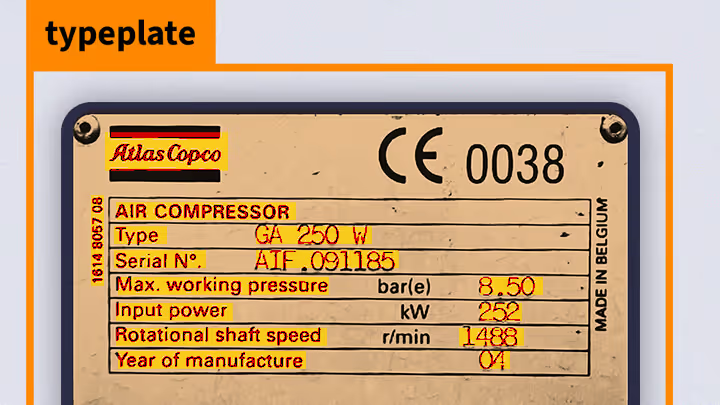
Bill of Materials (BOM) logic connects machines to their components and assemblies. When a service technician photographs a type plate, nyris Type Plate Recognition identifies the machine and narrows the search to its specific BOM. No serial number entry required. The technician then photographs the part, and the system searches only the relevant components for that machine.
Data curation improves what gets indexed. Clean, structured, and complete product data with the right images raises retrieval accuracy significantly. Where real images are missing or insufficient, nyris generates synthetic images from CAD files to fill coverage gaps. The nyris platform also includes tools to identify duplicates and low-quality entries, so the search index stays accurate as the catalog grows.
Visual Synonyms (Visual Knowledge Database) grows the system's visual parts intelligence over time. Through the nyris portal, real search queries showing parts as they appear in the field are added to the index. Every matched query becomes a new visual synonym for that product. The catalog starts with studio images, but over time the system learns what parts look like in real conditions: dirty, worn, partially visible, or photographed at odd angles.
Each of these steps compounds on the embedding foundation. The nyris visual search platform combines all of them into a single production system that regularly exceeds 90%+ end-to-end accuracy.
The benchmark shows three things that matter for anyone building or buying a visual search system:
Spare parts identification demands specialized models. On the Clips & Connectors dataset, where parts differ by small visual features, the best general-purpose foundation model (DINOv3) reaches only 26.4%. nyris scores 63.4%. For industrial part identification, domain expertise is not optional.
The embedding model choice matters enormously. A 15-percentage-point gap in average Accuracy@1 between the best and second-best model means a large difference in candidate quality entering every downstream stage. A better embedding makes every subsequent step more effective.
Embedding size does not predict accuracy. nyris proves that a focused, well-trained 768-dim model outperforms models with nearly twice the dimensionality. Better results at lower cost.
nyris embedding models are the best-performing visual product search and parts identification embeddings we have tested. They beat models from Google, Meta, Cohere, Jina AI, and Nomic AI in all our benchmarks with a compact 768-dimensional embedding that keeps infrastructure costs low.
The embedding is the foundation. The nyris visual search platform builds on it with re-ranking, OCR, hybrid search, filters, BOM logic and data curation to exceed 90% accuracy in production. From automotive spare parts to industrial connectors to retail products, every layer of the system works together, and it starts with the strongest retrieval stage in the industry.
Full benchmark results and methodology at https://benchmark.nyris.io.
You can read the paper here: Benchmark Report (arXiv)
Want to test our embeddings on your own product catalog? Contact us at embeddings@nyris.io.

Get answers to your specific question, and find out why nyris is the right choice for your business.