By
Markus Lukasson
Share this post

We’ve analyzed hundreds of hours of keynotes and panel discussions on Field Service and Aftersales to get the most mentioned trends for 2026. Here are the 10 trends and challenges that are actually shaping the future of Field Service and Aftersales as we head toward 2026.
The harsh reality for 2026 is simple: without clean data, almost every other trend on this list is impossible. Whether you want to deploy AI, automate parts identification, or launch predictive maintenance, "garbage in" will only result in "garbage out". In 2026, companies must focus on their "dirty data lakes" and fragmented records across ERP, CRM, and PLM systems. The top priority is Master Data Harmonization to create a "single source of truth". Without this foundation, you cannot connect your teams, you cannot automate processes, and you certainly cannot scale the innovations driving the future of service.
Once the data is clean, the conversation shifts from "AI will do everything" to "what can AI actually fix today?" The answer is administrative burden and knowledge gaps. We aren’t seeing a robot takeover, but rather a focus on practical tools that automate scheduling, streamline reporting, and surface "tribal knowledge" for new hires. The challenge now is implementation; without a clear roadmap, AI initiatives risk failing or feeding "garbage out".
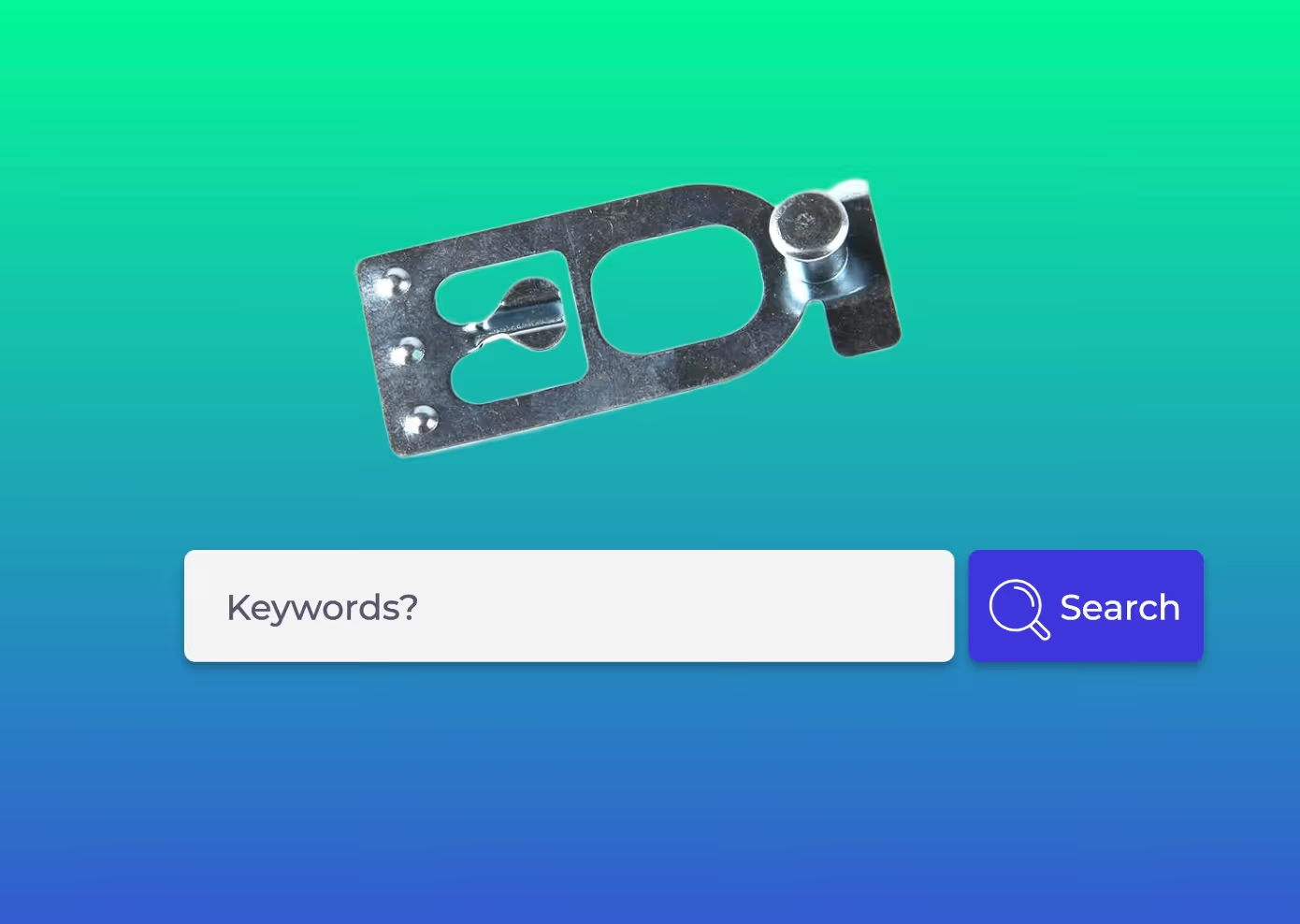
We are moving beyond simple search bars or static catalogs. The new standard for 2026 is "agentic search", a smart assistant that acts as a digital subject matter expert for every technician. Currently, service teams suffer because technicians are shotgunning parts (ordering five spares just in case) or wasting hours calling colleagues because they lack the specific knowledge to identify a component.
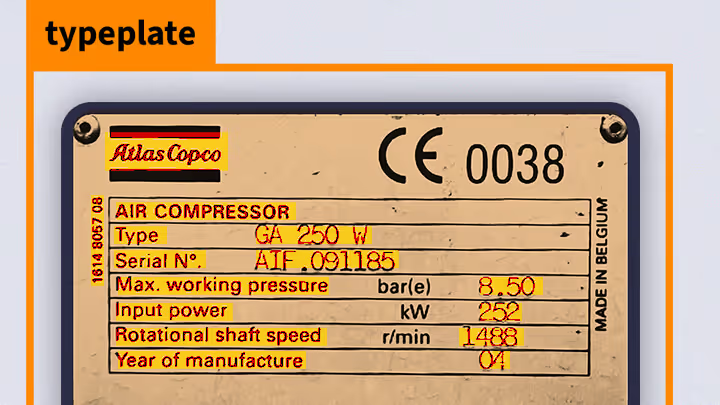
By combining Visual AI (snapping a photo of the part) with Context (knowing the asset history, CAD & Bill of Materials) and Expert Knowledge (pulling answers directly from technical manuals), these agents guide the user to the precise solution. We are moving from one-shot search to AI search assistants that guide the user until the exact required part is identified.
The move from selling products to selling "outcomes" (Servitization) is evolving into a stricter Platform Economy. It’s no longer enough to just launch a digital service. Companies are applying rigorous stage gates to their digital products. Every new platform, whether for IoT or customer portals, must now pass through a "Proof of Customer Value" and a "Proof of Monetization" before scaling. The goal is to move contracts from Capex (buying hardware) to Opex (paying for availability), but only if the ROI is proven.
The "Amazon effect" has hit the OEM industry. B2B customers now demand the same usability and interaction they get in their personal lives: user experience-optimized interfaces, fast search, real-time tracking, and instant self-service. Whether it's tracking a technician like an Uber driver or interacting with a chatbot, the expectation is consumer-grade simplicity. The challenge for 2026 is upgrading clunky backend systems to support this "B2B 2C" standard, ensuring that interacting with a service platform is as easy as using a smartphone.
While often called the "Holy Grail," the industry is getting realistic about Predictive Maintenance. The specific target is "On-Condition" maintenance, intervening only when data indicates a failure is imminent, rather than sticking to arbitrary calendar schedules. However, success here requires a cultural shift: customers must trust the data enough to pay for uptime rather than hours and labor, and legacy assets must be connected or monitored in new, creative ways.
The industry faces a dual crisis: a wave of retiring engineers taking expertise with them, and a struggle to attract younger talent who view field service as "dirty" work. To survive, organizations are normalizing hybrid roles where remote resolution is the primary line of defense, solving up to 70% of issues without a site visit. Simultaneously, companies are trying to rebrand the profession to attract diverse demographics, including women and digital natives who demand flexibility.
Global instability has exposed the fragility of "just-in-time" efficiency. The new reality is a "just-in-case" strategy, where companies are increasing safety stock and "nearshoring" manufacturing to regions like Eastern Europe to avoid disruptions from crises like the Red Sea attacks. Service leaders are realizing that meeting SLAs is impossible without a risk-aware supply chain that predicts disruptions rather than reacting to them after parts are already missing.
What started as a regulatory hurdle is becoming a data strategy. New EU regulations are forcing the adoption of "Digital Product Passports" to track a product’s entire lifecycle, from origin materials to repair history. This is emerging as a key enabler for the circular economy, helping manufacturers make faster, data-backed decisions on whether to recycle, remanufacture, or repair an asset at the end of its life.
Sustainability has graduated from a "nice-to-have" to a hard commercial requirement. It is now a competitive advantage in RFPs, with customers demanding proof of energy efficiency, waste reduction, and extended asset lifecycles. The service mindset is now intrinsically linked to sustainability, as keeping a machine running longer is the ultimate green practice.
If you want to prepare your master data for the AI era and provide your technicians with the B2C-grade Parts Intelligence they expect, we can help.
Schedule a call with us today to see how synthetic data, visual identification and agentic search can transform your service and after sales operations.

Get answers to your specific question, and find out why nyris is the right choice for your business.