By
Markus Lukasson
Share this post


Why does parts identification cost you so much time and expert resources? It is not because your customers or service technicians are lazy. It is because you are forcing them to translate a visual reality into keywords.
You are asking them to describe complex parts using words. That is where the error happens. Language is a translation layer, and translation is where accuracy dies.
Think of the children's game of Telephone. Information is lost and distorted the moment you try to describe reality. Converting a complex object into a linear text string will always involve data loss.
But let’s be clear: All search is a probability game. Whether you use keywords or images, the system is calculating the statistical likelihood of a match. There is no such thing as 100% perfection in search.
The difference lies in how much information is lost before you calculate a match.
Visual identification removes the translation error. It does not guess based on what the user says, It matches parts based on what the user sees. It uses the geometry and visual features of the part itself, the visual fingerprint, rather than a vague description in a database field that hasn't been updated since 1995.
Many OEMs tell us they can't use this technology because their data is not ready, or they have no images. They think they need to clean up everything before they can start.
This guide explains why that is the wrong approach. You don't need perfect data to move beyond the search bar.
Often when we sit down with a new client, we hear the same story. "We would love to use visual identification but our data is not ready. We have to clean it and collect images first.”
This is a trap. You will never have perfect data.
You have machines in the field that have been running for 30 or 40 years. The data for those legacy units is often just PDF catalogues or a technical drawing from 1995. Even for your newer machines, the data is fragmented. Your suppliers change their article numbers or update their component specs, and that data rarely makes it back into your ERP in real-time.
Waiting for perfect data is a death sentence. It paralyzes you.
The reality is that most OEMs have usable images for maybe 5-20% of their spare parts catalog. The other 80% is a black hole. You cannot solve a 25,000 SKU problem by hiring a summer intern to take photos in the warehouse. You cannot stop your business to conduct a five-year forensic audit of your inventory.
You need a mechanism that works around the data you have, not one that waits for the mess to be fixed.
You are hoping that eventually, your customers will learn to describe your parts correctly. You are hoping that with enough training manuals and portal tooltips, they will stop calling a "hydro-pneumatic accumulator" a "pressure tank." That will never happen.
The language barrier is not going away. In fact, as you grow globally, it gets worse. You cannot control how a technician in Brazil describes a part compared to a technician in Germany. You cannot force a standardized vocabulary on a chaotic world. Text-based search requires your customer to speak your internal engineering language. That is a losing battle.
The only universal language is visual. A photo of a broken valve looks the same in every country. It bypasses the translation layer entirely.
You need to stop waiting for your text descriptions to be perfect. They never will be. You need to start building a visual database that renders language irrelevant. This does not happen overnight. It requires a strategy for capturing reality, whether that is through synthetic data from CAD or a structured process for photographing real parts.
We wrote a specific guide on how to start this capture process, which you can read here:
A Practical Guide to Creating Images for Spare Parts
The sooner you accept that words are the bottleneck, the sooner you can build a system that works without them.
Most companies treat visual identification as a "reward" they get only after they have finished their massive data cleaning projects. They think, "Once our data is clean, then we can do the advanced stuff."
This is backwards.
You should not wait for clean data to start visual identification. You should use visual identification to force your data to become clean.
When you deploy a visual search project on just one machine line, it acts as a forensic audit. It immediately exposes exactly where your gaps are. It shows you which parts have no images, which IDs are mismatched, and where all the data can actually be found in your company. It acts as a catalyst. It creates urgency and focus that a boring "data governance" meeting never will.
If you wait until you have perfect data to start, you will be waiting ten years. You need to start now, with the data you have, and let the tool highlight the work that needs to be done.
This is not a quick fix. It is a commitment to modernizing your infrastructure one machine at a time. We outlined exactly how to make this transition in this article:
Efficient Spare Part Identification: From Guesswork to Instant Visual Recognition
Start with the mess. Let the technology help you clean it. But do not wait.
Your service technicians are not afraid of AI. They are afraid of wasting time.
They know where the paper catalog is. They know which PDF has the explosion drawing. They have memorized the path of least resistance. If your new digital tool is slower than their old paper catalog, they will not use it.
But watch what happens when it works.
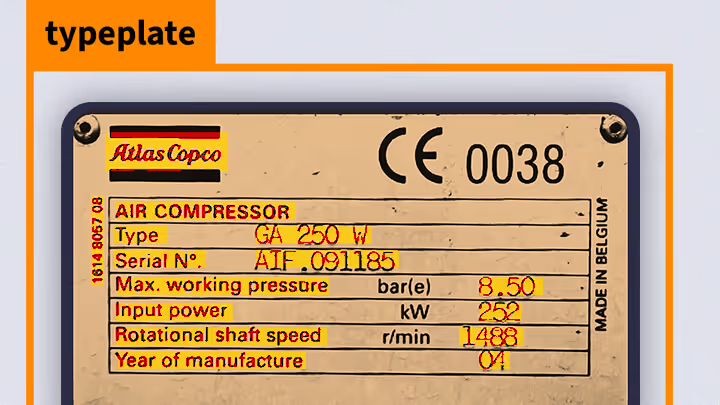
When they can snap a photo of a dirty type plate to extract the serial number, they use it because they hate typing 20-digit strings. When they can snap a photo of a broken component, they use it because they don't need to know if you call it a "valve" or a "regulator."
They do not need to be experts. They do not need to speak your engineering language. They only need to show you the part.
Visual intelligence is a compound asset. The earlier you start collecting data, the smarter it gets. Every day you wait is not just a delay, it is a lost opportunity to capture the tribal knowledge that runs your business.

Get answers to your specific question, and find out why nyris is the right choice for your business.