By
Markus Lukasson
Share this post

Skilled workers are scarce. Machines are getting more complex. Parts catalogs keep growing. Global teams add language and process gaps. When seasoned service technicians leave, you lose their tribal knowledge. Service queues pile up. Problems spike.
Right now your tech and support teams scroll PDFs, squint at thumbnails, search archives and guess from memory. When they get stuck they ask Mike for help. He has worked for you for twenty years. Unfortunately, Mike is a human being and not always available. Time-to-offer for spare parts requests is at least two days.
Here is a solution approach for a more efficient way: a visual parts identification system you roll out in one clean pilot, then scale company wide. It is not magic. It is maturity. Data readiness, pilot discipline, and scale patterns that do not crumble under real usage.
If you are tired of endless AI pilots that never leave slideware, let us build the version that ships.
Promise: Useful first results in under 30 days with a pilot your users love
Gather a sample of 100-1000 parts, ideally from one machine, warehouse, location, or category. Choose a set where visual identification can be easily validated by visiting the warehouse or shop floor.
No images, no drama. Visual identification works best with, of course, images. If you already have them, great. We can start right away. If not, we can close the gap quickly using your CAD data or simply a smartphone.
Make sure to add all the metadata you have for your parts. Electronic parts, circuit boards, and similar items often have serial or type numbers printed on them. Make sure this data is included in your metadata. Optical character recognition within our hybrid search will be able to find those parts by image or text.
Pick one site or team for the pilot and name a champion user. One place. One service technician who will give you blunt feedback. One champion. This keeps you fast and politics quiet.
A large-scale technology project is risky and slow. An agile prototype is a smarter way to start. The goal is to deliver a working tool to a small group of users in 30 days. This approach minimizes risk, demonstrates value quickly, gets your team excited about the new tool and delivers numbers for your budget discussions with finance.
Most pilots fail because they try to please everyone. Do the opposite. One use case. One site. One metric. That is your lane.
Start by picking a high friction scenario. Think field tech identifies worn seal on a pump from a phone photo or warehouse stuff trying to put returns back in stock. If you have to think too hard, check the last 30 service tickets. The patterns are there.
Choose a single pilot site. A place with high volume and a champion who answers messages. This is about speed of learning, not a press release. If two sites are politicking, pick the one with a named champion.
Your metric is simple: Time to identify. It’s easy to measure and hard to argue with. You will set baselines this week.
Baseline them with simple math. Pull a 10 to 20 ticket sample. Time how long identification took. Have your champion rate whether the first result would have been useful if the tool existed then. Yes or no.
Write your scope in one page. This is your guardrail when helpful people try to expand scope. If it is not in the one pager, it is a phase two conversation. Protect the 45 day clock.
Use this copy paste baseline sheet to get moving fast:
Pilot Use Case: [e.g., Field tech identifies parts for machine A from phone images, Warehouse identifies returned parts]
Pilot Site: [e.g., Plant A, Service Bay 3, Warehouse 1]
Champion User: [Name, role, contact]
Success Metrics: Time to identify (T2I): Baseline [mm:ss], Target [mm:ss]
Data Sample: SKUs: [count], Images per SKU, Attributes available: [list
Pilot Window: [Start date] to [End date]
Weekly Cadence: [Day and time], Attendees: [names]
Be explicit about what is not a goal. You are not rebuilding taxonomy. You are not starting a product data cleansing project. You are not integrating with SAP. You are not solving every edge case. You are proving value for one use case.
Get sign off from the sponsor and the champion. A quick thumbs up in writing is enough. This gives you cover when scope creep taps on the window.
Now you have a lane, a clock, and a scoreboard. Next, we make the minimum data clean enough to win.
Perfection is the enemy. We will clean only what improves search quality. Unique material ID, title, visible attributes as Metadata and images, or CAD data, that’s it. We don’t need more to begin with.
Put it in an Excel file or Google Sheet and share the images or CAD file securely with the nyris team. Don’t have anything like this except a PDF catalog? That’s fine, we can start from here.
Capture images for selected parts using the nyris image collector app. It will directly sync your data with the visual search prototype. You can instantly test what you have captured.
or
Share the CAD files of your parts or your complete machine, and we will do the rest. The nyris team can extract reference views and generate synthetic image data directly from CAD models to accelerate your prototype setup.
You already have done all the work needed. The rest is on us to get started.
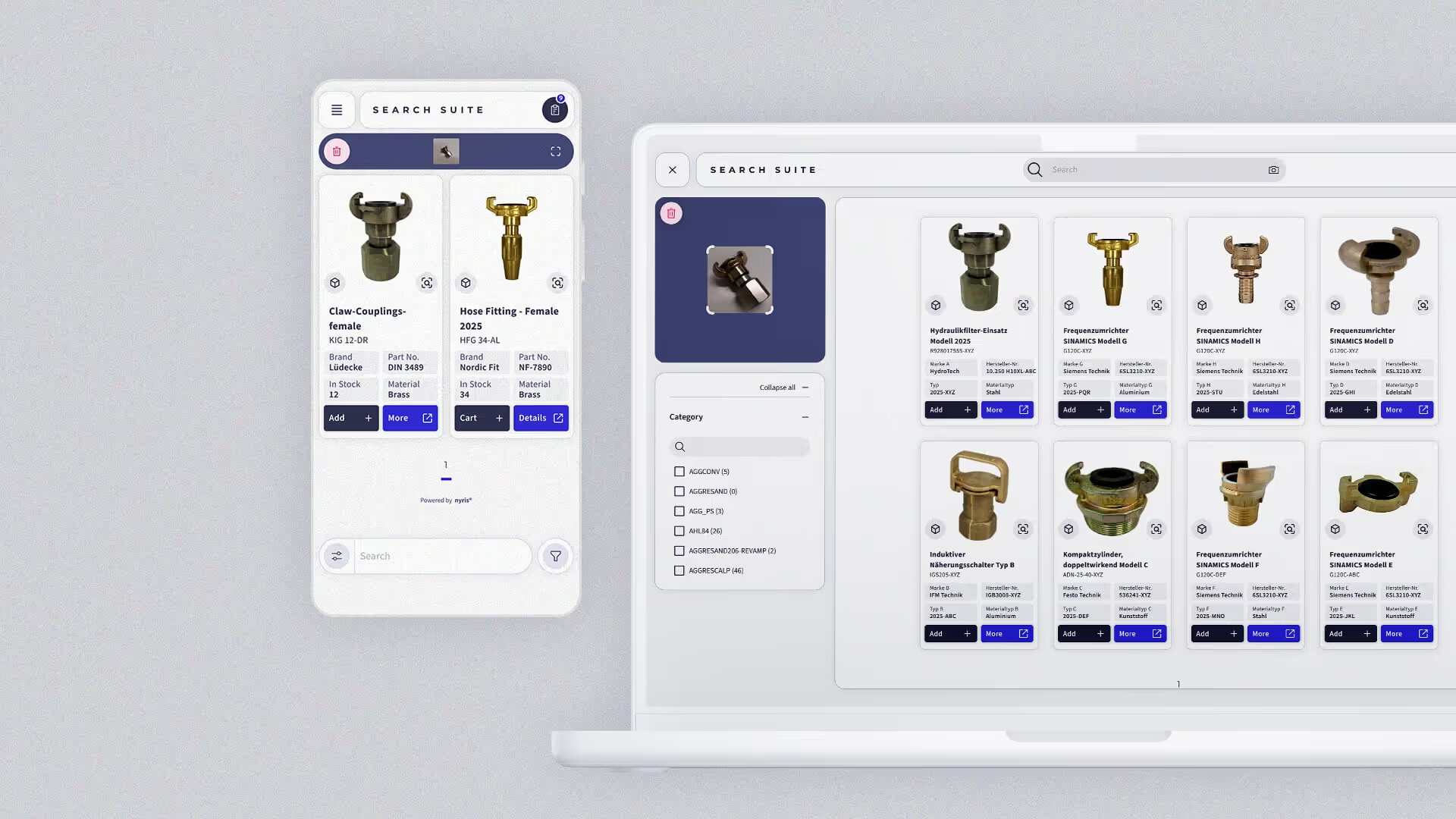
The nyris search suite App will be ready for you. This dedicated application will be securely connected with your spare parts data, ensuring a real-time, accurate, and comprehensive search experience. There is no waiting period for integration or final commitment. You can commence testing the full capabilities of the nyris search suite right away.
Image Search (Visual Recognition): Utilize the app's core strength to find spare parts instantly by simply taking or uploading a photograph. This eliminates guesswork and manual catalog searches.
Text Search: Standard text-based querying remains fully supported, leveraging advanced algorithms for high-speed, relevant results.
Barcode Search: If a barcode is present in the image you capture and its value matches one of your products, the product will also be found.
Advanced Recognition Capabilities
To further streamline the identification process, the nyris search suite incorporates powerful supplemental technologies:
Optical Character Recognition (OCR): Identify and utilize text, part numbers, or serial numbers found within an image, making even partially obscured or hand-written information searchable.
ID Pattern Matching: Our system can recognize and match proprietary or standardized identification patterns, adding another layer of search precision, particularly useful for complex industrial equipment.
Hybrid Search: You can use additional extracted features from images, such as context, smart filters, predefined or free attributes you would like to extract from the image to create an even better search experience for any user scenario.
Pilots die from vague feedback. You will run a tight loop with a Golden Test Set and scorecard.
Recruit 2 to 5 champion users. Technicians, Service Agents, or buyers who actually touch the problem. Not just their managers. Reward them with time saved, not swag. They will show up if the tool helps. Record a small session how to use the tool and share it with them. We can help out here if needed.
Create a Golden Test Set. Take 50 images of your parts. Those images can be from the warehouse, service desk, customer requests. Annotate them with the product ID of the item in the image. This becomes your truth set. We can help you run this test set automatically to measure the actual identification accuracy.
You will also get comprehensive access to the nyris portal. This dedicated platform allows you to meticulously review every search request, investigate why a specific item was or was not successfully identified, assign additional reference images to existing items for better accuracy, and gain full transparency into the visual recognition process.
That’s it. Within two weeks, this should provide sufficient data to justify the next steps and inform the requirements for a full company-wide rollout.
Ready to fast track your pilot: Schedule a free 1 hour consultation with us

Get answers to your specific question, and find out why nyris is the right choice for your business.